Use this checklist to define what a wire rope assembly must be before asking for a quotation. It focuses on the technical specification, not on a generic supplier search.
Start with the references that define assembly fit
A useful wire rope assembly specification tells a supplier what the cable must connect, how its length is measured and which details are confirmed versus still open.
If a drawing or sample identifies the construction as 7x7 or 7x19, see the Wire Rope 7x7 vs 7x19 comparison guide for a buyer-side overview; confirm the selected construction against the project drawing or supplier review.
Unknown values should be marked To be confirmed during RFQ. That keeps the request precise without inventing a dimension, tolerance or fitting specification.
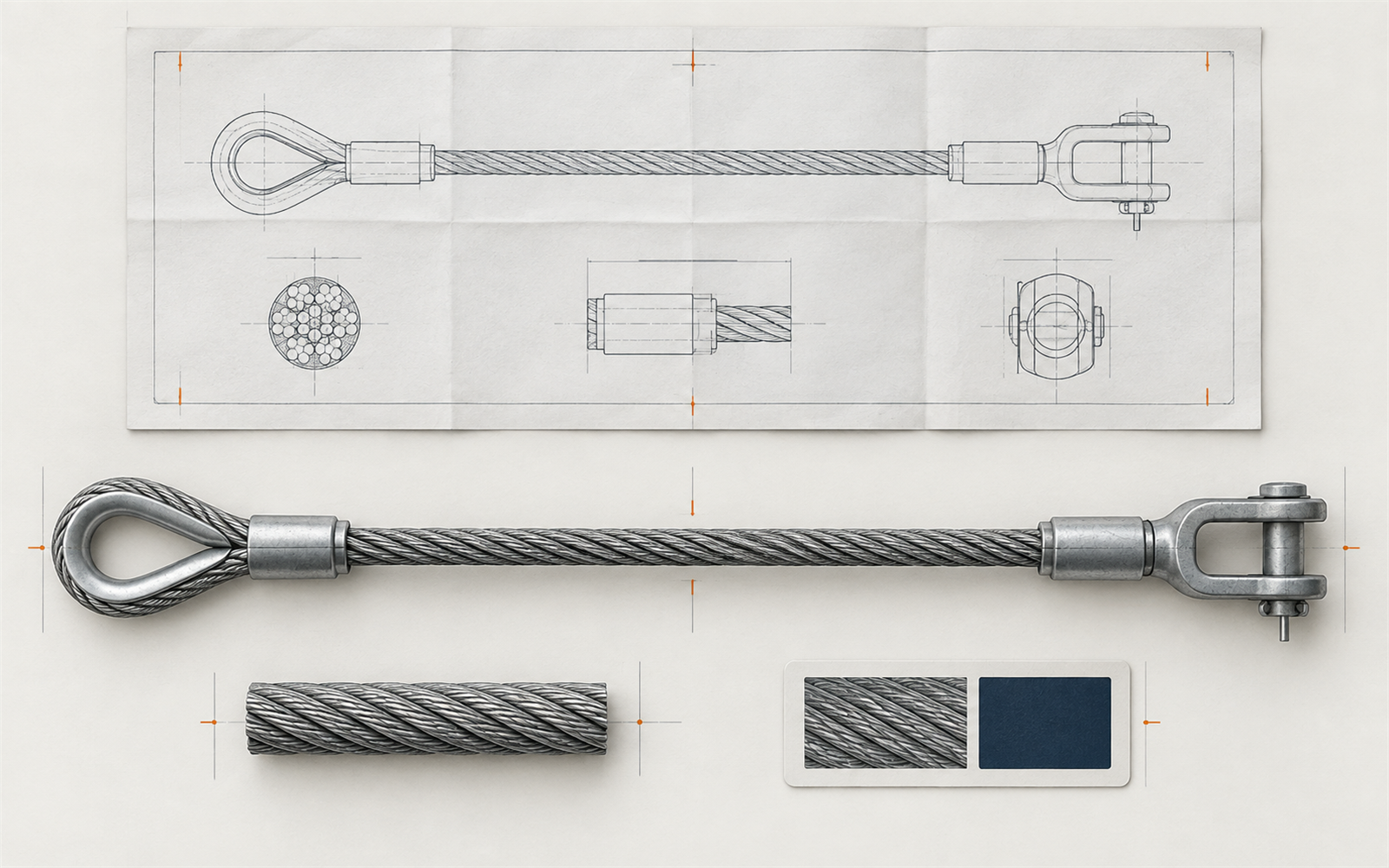
End ACable bodyEnd BDrawing / sample
Explanatory technical illustration. Use the drawing, sample or application reference to confirm the final assembly details during RFQ.
Cable
Construction, material, diameter and coating or surface finish.
Diameter
Record the cable diameter from the drawing, sample or product reference.
Length reference
State overall assembly length and every reference point for loops, terminals and protected sections.
End A
Define the fitting, orientation and mating hardware for the first end.
End B
Define the fitting, orientation and mating hardware for the second end.
Coating
Record coated or uncoated condition, colour or surface preference, sleeves and protective parts.
Application
Explain whether the assembly suspends, retains, routes, connects or replaces a cable in the equipment.
Drawing / sample
Provide a drawing, sample or photos from multiple angles with a ruler or sketch.
Quantity / packaging
State quantity grouping, labels, protection and whether packing is by piece, set, machine model or project batch.
Reference the assembly from end to end
This explanatory plate shows the reference points to define in an RFQ. It is not an engineering drawing and does not set dimensions, tolerances or material grades.
Explanatory reference only. Confirm dimensions, fitting descriptions and open points during RFQ.
On small screens, use the reference list below for readable labels.
End A
Record the first fitting and its orientation.
End B
Record the second fitting and its orientation.
Overall length
State the measurement reference points.
Cable diameter
Use the drawing, sample or product reference.
Coating / jacket
Record the known surface or protective condition.
End fittings
Identify mating hardware or mark it to be confirmed.
A specification is a set of references, not only a cable name
A useful wire rope assembly specification tells a supplier what the cable must connect, how its length is measured and which details are confirmed versus still open. Start with the application and the nearest product family, then document the cable body, end fittings and evidence available.
The existing How to Request a Custom Wire Rope Assembly Quote article explains the communication process. This guide answers a different question: what technical specifications should be defined before that request is sent?
Use the specification table as an RFQ working sheet
Record the known value, then attach the evidence that lets the supplier review the request without guessing.
This table has three columns. On small screens, move the table horizontally to read all fields.
Specification area
What to record
Useful evidence
Construction and material
Wire rope construction, material, diameter, coating or finish if known.
Drawing, product reference, sample or application notes.
Length
Overall assembly length plus the reference points used for loops, terminals and protected sections.
Dimensioned sketch, drawing revision or measured sample.
End A / End B
Each end separately: loop, sleeve, ferrule, thimble, hook, terminal, thread or other fitting.
Close-up photos from multiple angles and mating hardware.
Coating and protection
Coated or uncoated condition, color or surface preference, sleeves and protective parts.
Application environment, sample finish or drawing note.
Evidence and commercial pack
Application, quantity, packaging, labels, drawing revision and any tolerance requirement.
Use fitting reference points to measure assembly length
“Overall length” is not complete until the starting and ending points are clear. Published supplier references show examples that vary with the fitting shape; use the project drawing and confirm the measurement method with the supplier.
Fitting arrangement
Example reference point
What to confirm
Eye or fork with a pin hole
Center of the pin hole or mating-pin center.
Whether the dimension runs between pin centers or uses another drawing datum.
Ball fitting
Center of the ball in some supplier references.
Whether the required point is the ball center, outer end or another datum.
Threaded stud or terminal
A defined terminal end; some ordering guides use the outer end of the thread.
Whether the length ends at the thread tip, shoulder, terminal face or another marked surface.
Wire-rope eye or loop
Bearing point of the mating pin in the loop in some supplier references.
Loop opening, intended pin size and whether the overall dimension includes the loop geometry.
These are supplier-specific examples, not a universal measurement rule. Mark End A and End B, draw arrows to the intended points and state whether loop or terminal dimensions are included. If the drawing does not define the datum, ask the supplier to confirm it before comparing lengths.
What to prepare before requesting a quote
Use this list to check whether the request includes the references a supplier needs to review the assembly.
Construction, material, diameter and coating or surface finish
Overall assembly length and every measurement reference point
End fitting A and end fitting B, orientation and mating hardware
Sleeve, ferrule, thimble, loop, hook, terminal or protective component details
Drawing revision, sample condition, quantity, packaging and application notes
Continue from specification to quotation
Use the related pages for product families, end fittings, drawing-based assembly and RFQ preparation.
Wire rope assembly specification questions
What is the first line of a wire rope assembly specification?
Start with the application function, cable type or reference assembly, and the drawing, sample or photo that defines the request.
Should overall length and fitting position be separate?
Yes. State the measurement reference points for overall length, loop or terminal position and any exposed or protected section.
How do I measure wire rope assembly length between end fittings?
Mark the exact reference point for each fitting on a drawing or sketch. Supplier examples use points such as a pin-hole center, ball center, loop bearing point or terminal end; confirm the chosen method with the drawing and supplier.
What if the end fitting name is unknown?
Send close-up photos from multiple angles with a ruler or sketch. The final fitting description is to be confirmed during RFQ.
Do buyers need to state packaging?
Include quantity grouping, labels, protection and whether the assembly is packed by piece, set, machine model or project batch.
Specification-led RFQ
Send the references you have
Drawings, samples, photos, measurements and application notes can be submitted together. Project-specific details remain subject to confirmation.